INPA wins CNPq funding: the HerbSpectra-Amazônia project is born
Good news is coming from the forest!
CNPq recently announced the results of the Call MCTI/CNPq No. 03/2025 - Pró-Amazônia, and the National Institute for Amazonian Research (INPA) had three proposals approved — among them, one that fills us with pride: the project “Amazonian Spectral Herbaria Network: Spectroscopy and artificial intelligence for the automated identification of biodiversity in Amazonian herbaria – HerbSpectra-Amazônia”, coordinated by Dr. Flávia Durgante, whose team and objectives are directly connected to the spirit of SpectraPop.
This approval is a milestone for the modernization of Amazonian botanical collections and for the advancement of spectroscopy as a complementary tool for identifying biodiversity. And, of course, it is a great collective achievement for all the Brazilian and international partner institutions involved.
What is HerbSpectra-Amazônia?
The project proposes something unprecedented in Brazil: creating the first international network of Amazonian herbaria equipped with NIR spectroscopy technology and trained to standardize the spectral reading of plants in scientific collections.
The central idea is simple: to digitize, in a standardized and accessible way, the spectral signatures of Amazonian plants; to train artificial intelligence algorithms to recognize species automatically; and to modernize botanical taxonomy, making it faster, more reproducible and aligned with emerging digital technologies.
For a biome with more than 15 thousand plant species, where traditional identification demands time, specialists and ideal conditions, the combination of AI + spectroscopy can change everything.
An Amazonian and international collaboration network
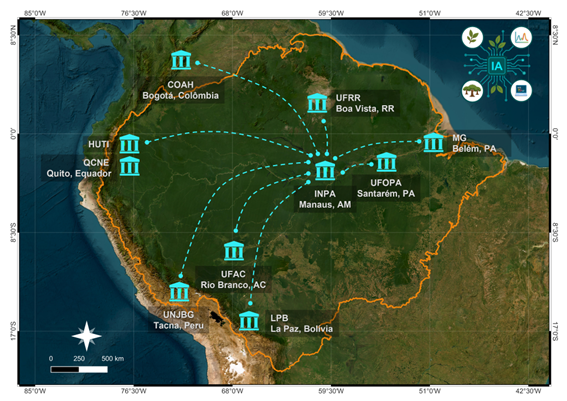
The proposal was submitted with the support of 16 national and international institutions, showing the reach and relevance of the initiative. The network of executing herbaria includes:
Five Brazilian herbaria
INPA – National Institute for Amazonian Research (Manaus, Amazonas) - coordinating hub
HSTM Herbarium – Federal University of Western Pará (Santarém, Pará)
MG Herbarium – Museu Paraense Emílio Goeldi (Belém, Pará)
UFACPZ Herbarium – Federal University of Acre (Rio Branco, Acre)
UFRR Herbarium – Federal University of Roraima (Boa Vista, Roraima)
Five herbaria from ACTO countries (Bolivia, Colombia, Peru and Ecuador)
All have already expressed interest in digitizing their collections, some even starting to acquire MicroNIR spectrometers.
- COAH Herbarium – Instituto Amazónico de Investigaciones Científicas SINCHI (Bogotá, Colombia)
- HUTI Herbarium – Universidad Tecnológica Indoamérica (Quito, Ecuador)
- LPB Herbarium – Instituto de Ecología de la Universidad Mayor de San Andrés/ Museo Nacional de Historia Natural (La Paz, Bolivia)
- QCNE Herbarium – Museo Ecuatoriano de Ciencias Naturales del Instituto Nacional de Biodiversidad (Quito, Ecuador)
- TKN Herbarium – Instituto de Investigación de la Universidad Nacional Jorge Basadre Grohmann (Tacna, Peru)
And more:
Leading international institutions that are members of iHerbSpec, such as the Harvard University Herbaria, the Missouri Botanical Garden, Aarhus University and the Karlsruhe Institute of Technology, also take part, offering expertise, training and global standardization.
Why does this matter?
The Amazon is one of the most diverse regions on the planet — but also one of the most challenging for taxonomists. Near-infrared (NIR) spectroscopy:
is fast
is non-destructive
is less costly than DNA-based methods
and is able to recognize chemical and physical characteristics of plants with impressive precision.
Recent research shows that spectral signatures can corroborate molecular results, predict functional traits and even identify species with high accuracy.
With thousands of samples being digitized in different Amazonian herbaria, the project will create the largest spectral database of the Amazonian flora, something unprecedented on a global scale.
And the AI models?
Another central axis of the project will be the development of machine learning models — from Random Forest to neural networks and deep learning — to recognize species, predict functional traits and test the transferability of the models between herbaria in different countries.
The team also plans:
the use of XAI (SHAP, LIME) to interpret models
documented pipelines published on GitHub and Zenodo
a minimum accuracy of 85% in species identification
A true technological revolution for Amazonian botany!
Training for the whole Amazon
The project has a strong training component, including:
online courses (in Portuguese and Spanish) on herbarium spectroscopy
in-person workshops in nine Amazonian herbaria
seminars on AI and biodiversity
a 40-hour international course on AI applied to biodiversity
creation of materials for science outreach and technical training
In other words: the project not only does science, it also trains people, builds networks and modernizes entire collections.
A bit of what we will deliver
HerbSpectra-Amazônia foresees, among other products:
A consolidated international network of spectral herbaria
Training of more than 100 people
A standardized spectral database
AI models for species identification
Scientific publications and reproducible scripts
A closing international workshop
The schedule spans 24 months, with lasting impact for the whole Amazon region.
Why is this also a victory for SpectraPop?
SpectraPop, funded by FAPEAM, has been fundamental in popularizing the use of plant spectroscopy in the Amazon, testing accessible equipment such as the MicroNIR and bringing the technique to students, technicians and communities.
Now, with HerbSpectra-Amazônia, this impact is multiplied: what began as a pioneering effort in Manaus becomes a pan-Amazonian network.
Let’s celebrate together!
With pride and enthusiasm, we celebrate this achievement alongside INPA and all the partners.
HerbSpectra-Amazônia represents the future of Amazonian botany — a future that is faster, more integrative, more technological and more collaborative. Soon we will share news: training sessions, workshops, courses and the behind-the-scenes of building this mega-project.
Amazonian science remains alive, strong and innovative. And we keep going together, illuminating biodiversity… one spectrum at a time.😅